
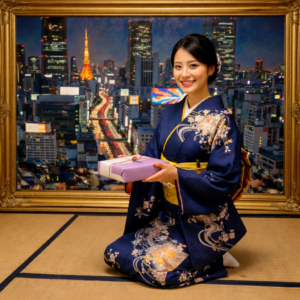
Ochūgen and Oseibo — How Gifts Connect People Through “Energy”
The Energy of Relationships Created by Gifts
In Japan, the culture of seasonal gift-giving—represented by Ochūgen (お中元、summer gifts) and Oseibo (お歳暮、year-end gifts)—has been gradually fading in recent years, especially among younger generations.
Many people feel uneasy or hesitant, thinking things like:
・“What if I don’t receive an appropriate return gift?”
・“I don’t know what I should give.”
・“The customs are complicated and troublesome.”
These feelings are understandable.
In Japan, gift-giving comes with its own unique etiquette, such as han-gaeshi (半返し、returning roughly half the value of a gift for occasions like childbirth celebrations), or sending formal thank-you letters in response to Ochūgen or Oseibo.
However, these long-established customs carry meanings that go far beyond the simple exchange of goods.
A gift is not only a way to express gratitude or celebrate another person’s happiness or life milestone. More importantly, it plays a role in creating and maintaining a relationship—something that flows between the giver and the receiver.
In other words, within gift-giving lies a deep wisdom:
the exchange of energy
In Japan, relationships have traditionally been built and sustained not through impersonal means like money, but through heartfelt gifts.
This reflects a uniquely Japanese sensibility—one that values the circulation of heart and ki (気、vital energy) over purely material worth.
The Flow of Ki Born from Giving
This idea of “energy exchange”, when expressed through Japanese aesthetics and sensibility, can be described as either:
・Circulation, or
・The flow of ki (気、vital energy)
In Japan, when valuing relationships—not only in Ochūgen or Oseibo, but in daily life as well—people emphasize an uninterrupted flow rather than one-directional consumption or acquisition.
・Giving
・receiving, and then
・ giving back again
— This continuous movement is deeply cherished.
Just as a river becomes stagnant when its flow stops, relationships lose vitality when this flow is interrupted. By maintaining circulation, energy (ki) continues to move, and healthy, enriching relationships are sustained.
If someone feels that giving a gift is “wasteful,” it may be because this circulation of energy is not being consciously perceived.
For example, imagine giving a gift worth 10,000 yen, only to receive a thank-you card or a gift worth about 5,000 yen in return. On the surface, it may feel like a loss. It may seem more rational to spend that money on oneself instead.
Yet in such thinking, no circulation of energy or relationship is created.
A gift can be worth more than its monetary value because it generates something invisible but vital: a relationship.
Through energy exchange, relationships with people and environments are formed, and within those relationships, even greater energy is created. Unlike physical objects, energy is not finite.
Even if nothing tangible returns in the form of another gift, the result may be positive events, favorable circumstances, or supportive environments that far exceed the original value. Even without expecting such outcomes, it is wise to cultivate conditions where this flow exists.
This is why a culture developed in which gift-giving allows both sides to move toward a better state.
Shosa — The Sense of Relationship Seen in Martial Arts
From Self-Centeredness to Relational Awareness.
This awareness of energy exchange with others is deeply valued in Japanese shosa (所作、embodied manners and movements), especially in martial arts and traditional arts.
Let us take Kendo(剣道) as an example, focusing on the concept of seme (攻め、pressuring or engaging an opponent).
At an inexperienced level, a practitioner may think:
・“I’ll strike the opponent’s head (面、men).”
・“I’ll attack the wrist (小手、kote).”
They act according to their own thoughts, attacking one-sidedly.
Here, awareness centers only on “what I will do.” There is no sense of relationship with the opponent—only the act of projecting one’s energy in a single direction.
For experienced practitioners, however, the approach is entirely different. They do not focus on their own movement alone, but instead engage through:
・the opponent’s movement
・the opponent’s ma (間、timing and spatial interval)
・the relationship with the opponent’s ki (energy)
When the opponent’s energy subtly falters, the practitioner uses that moment—drawing upon the energy released by the opponent—to strike. Only then does true energy exchange occur.
In Kendo, the principle of ki–ken–tai no icchi (気剣体の一致、unity of spirit, sword, and body) can never be achieved alone. It becomes possible only through energy exchange with an opponent.
In particular, the subtle offense and defense of ki—perceiving the opponent’s energy and extending one’s own toward them—is energy exchange itself.
This principle is shared with Aikido(合気道), where techniques utilize the opponent’s force, and with the tea ceremony(茶道), where host and guest mutually sense each other’s movements and breathing to create an ichigo ichie (一期一会、“once-in-a-lifetime”) moment.
When we become conscious of energy exchange, we gradually move away from the mindset of “trying to control others through logic.” Instead, we begin to act from relationship:
・the other person’s movement
・their thoughts
・their timing
・the tension and direction of their energy
From these relationships, our own actions naturally arise.
This is what is often described as “being in the flow.”
Just as with gift-giving, by creating circulation of energy in various aspects of life, we allow energy to move through relationships. As a result, we move toward a richer, more harmonious state of being.