
A Single Flower — The Breath of Beauty in “Imperfect Wholeness”
A Single Flower in Harmony with Space
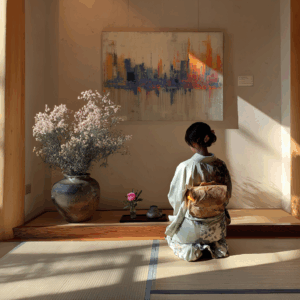
In a tearoom, a single flower is quietly arranged.
Beside it blooms a large, showy flower in full color and fragrance.
Which one draws your heart more deeply?
Most people are first captivated by the larger bloom.
Yet those familiar with Japanese culture are naturally drawn to the single, humble flower.
This is because chabana (茶花, the flower arrangement used in tea ceremony), presents flowers just as they grow in the wild — simple, unadorned, and sincere.
It does not seek attention, yet it has a quiet power that moves the heart.
That single flower never dominates the space.
Instead, it breathes in harmony with the air and light around it.
We sense beauty not so much in the flower itself, but in the atmosphere it creates — a delicate blend of presence and transience.
By contrast, a large flower can be delightful as a gift,
but if placed in a tearoom, it disturbs the quiet rhythm of the space.
In nature, no flower blooms excessively.
When beauty becomes artificial, it easily disrupts the balance of nature’s harmony.
In Japanese aesthetics, beauty shines only when it resonates with its surroundings.
It lives quietly within things that do not try to stand out.
Becoming Beautiful Through “Less”
In Western aesthetics, beauty often seeks to be “complete.”
Paintings and architecture fill every space to create order and perfection.
In Japanese aesthetics, however, emptiness — or “ma” — is the richest space of all.
Emptiness does not mean “nothing.”
It is a space filled with potential, where something new may emerge.
To place only one flower is to leave something incomplete,
giving the viewer’s imagination room to breathe and participate.
This sensibility also appears in haiku(俳句).
Within just seventeen syllables, poets never describe everything.
By leaving parts unspoken, the reader’s heart fills the silence.
Beauty emerges not from fullness, but from what is left unsaid.
It is in this dialogue between space and the human spirit that the work becomes complete.
Because something is missing, movement and life arise.
A room overflowing with objects leaves no room to move —
but space, or yohaku(余白, the art of empty space), allows freedom, renewal, and lightness.
To “know sufficiency” (taru wo shiru‘, 足るを知る) is to feel this quiet fullness in what appears incomplete.
Shosa — The Power of Small Movements
To embody the beauty of yohaku,
we must first remove what is unnecessary.
Then, within the smallest remaining movement, true meaning emerges.
Such subtle refinement cannot be achieved all at once; it must be cultivated slowly.
In kendo(剣道), the more advanced a practitioner becomes, the less they move.
A slight shift in posture, a subtle change of gaze, a quiet rhythm of breath —
these alone can draw in the opponent and control the entire space.
This is known as sasoi(誘い, the art of invitation).
To the eye, the body may appear still, but the invisible movement of energy fills the space.
This is very different from itsuki(居付き, a state of stagnation).
At this level, one no longer attacks needlessly, strikes with force, or adds tension.
By reducing motion and effort, one gains greater power.
To contain movement within stillness — that is the essence of Japanese shosa.
The same is true in chado(茶道, the way of tea).
Every motion is deliberate, with nothing wasted.
Beauty arises not from speed or perfection, but from the rhythm of breath and the harmony of timing — the ma(間).
As movements grow smaller, space expands and the mind becomes clear.
Shosa is not simply physical motion.
It is an act of aligning one’s breath with the surrounding space.
Just as a single flower calms the air of the tearoom,
a quiet gesture can transform the atmosphere of an entire place.