
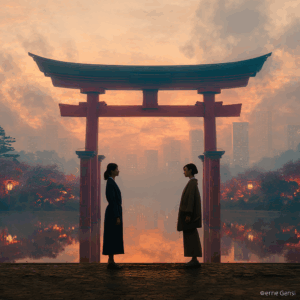
The Torii Gate — Sensing the Boundary Between Human and Divine
The Space of Ma Between Gods and People
We do not live in isolation.
Every day we exist within countless relationships — with people, with things, and even with invisible forces. It is within these in-between spaces that our true lives unfold.
At a Shinto shrine(神社), the torii gate (鳥居)symbolizes this sense of Ma(間)—the charged, living space that exists between two realms. A torii marks both a boundary and a passage between the world of humans and that of the divine.
When you stand before it, you are poised between the ordinary and the sacred.
Your breath naturally slows, your heart grows still, and a subtle awareness arises.
That sensation — the quiet tension between two worlds — is what it means to feel Ma.
When we become aware of Ma, our way of seeing changes.
We stop forcing our own perspective and begin to act while sensing the rhythm, the breath, of others and the surrounding environment.
This awareness also exists in martial arts.
In kendo, if one misjudges ma-ai—the interval between opponents—by even a few centimeters, it can mean being struck down, symbolically, “death.” Within the narrow tension where bamboo swords almost touch, practitioners must sense the opponent’s breath and intention, creating the most fitting distance.
Thus, Ma is not simply a matter of space or distance.
It is the breathing field that allows people, gods, hearts, and the world to connect.
Creating Ma with the Divine — The Art of Respect
Step through the torii gate.
With that single step, you cross from the human world into the divine. Quiet your breathing, sharpen your senses, and notice the changes in air, light, and sound around you. In this awareness, a relationship begins to form—between you, your surroundings, and the sacred.
You may notice the scent of cedar, the sound of running water, the texture of gravel beneath your feet. Through these sensations, the outer world softens and your inner world becomes clear.
The shrine path (sando, 参道) is the way that connects humans and deities.
The center of the path is believed to belong to the gods, so we walk quietly along the side, with a calm posture and gentle steps. This mindful movement itself is a way of creating Ma.
At the temizuya (purification basin,手水舎 ), you rinse your hands and mouth. This act is not mere formality—it is a small ritual that allows the heart to leave the outer world and prepare to enter the sacred. In the pause between each gesture, inner stillness arises.
Standing before the main hall, your breath deepens naturally. The bow (rei) you offer is not just a physical movement; it expresses gratitude and respect for both the divine presence and the space that holds you.
Ma is more than distance.
It is the invisible margin that allows people, gods, hearts, and the world to breathe together. Within each step—passing through the torii, walking the path, offering your bow—
a quiet, unmistakable sense of Ma is alive.
Shosa — Creating the Right Ma: Far to the Opponent, Close to Oneself
In the world of competition and combat, the concept of Ma cannot be separated from mastery itself.
In kendo, a difference of only a few centimeters in distance can mean defeat—or death. Kendo refines Ma through the relationship between people and the space that connects them.
Practitioners often speak of “creating a distance that feels far to the opponent, yet near to oneself.” This may sound paradoxical, but Ma here involves more than physical distance.
It includes breath, rhythm, centerline, timing, and awareness— all combined to achieve a delicate balance where one feels close and in control, even while remaining outwardly distant.
In chado (the Way of Tea, 茶道), Ma manifests differently. Within the compact space of the tearoom, host and guest coordinate their breathing, gestures, and gaze, responding sensitively to each other’s movements and presence.
Here too, an exquisite sense of Ma comes to life.
Rei (礼)—the bow of respect—is a gesture shared across all traditional Japanese arts.
Through rei, we express our awareness of the space between ourselves and others.
This simple motion softens boundaries, harmonizes breathing, and opens the way to aiki(合気)— a state where mutual awareness and energy move as one.
Through such shosa—refined, intentional movements— we come to understand how breath, posture, and awareness create the most fitting Ma for each moment. To live and act within this harmony is to embody the beauty of Ma itself.