
The Zen Garden — What Appears When You Subtract
More Than Water — The Zen Garden’s Art of Absence
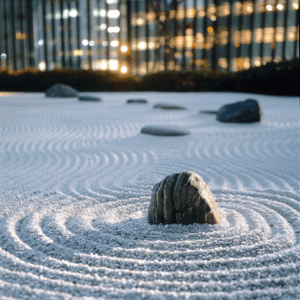
Stand before a karesansui (a Zen dry-landscape garden,枯山水) and you’ll see “flow” even though no water is used. With little more than stones and raked gravel, the garden lets you feel a quiet current—an intentional choice to evoke the presence of water without actually using it.
Must water be present to let us feel water? Japanese sensibility knows this paradox well. Even without water, one can draw a scene that surpasses water itself.
In other words, the beauty of what is not there can exceed the beauty of what is. When something is missing, our senses begin to complete it.
Today, information and things are almost always within reach. The more we chase and acquire them, the thinner this yohaku (blank space,余白) becomes—and the harder it is to notice true beauty.
Because of Absence, Presence Emerges
There is no mountain stream before you. There is only white gravel and stones. The gravel meanders in fine lines, suggesting the flow of a river or the ripples of a pond; the stones call up the presence of surrounding mountains or a waterfall.
Morning light and the glow of sunset reveal different aspects; the seasons change the mood as well. Even your own state of mind alters what you see.
Here lies Japan’s “aesthetics of subtraction”: remove as much as possible so the viewer can feel and enjoy the scene for themselves.
Imagine this: what kind of garden fits you best?
The garden you just envisioned is the garden for you—and karesansui can express it. Having the “real thing” in front of you isn’t always the point. When what is in front of you is withdrawn, your ideal scene can appear.
Shosa — Move Largely, Move Mindfully
The yohaku is not created by cutting things at random. The more you remove, the more carefully you must attend to what remains. In the karesansui, that means meticulous decisions about stone placement and the patterns raked into the gravel.
The same is true of shosa (refined, intentional movement). Shosa has been honed into motions with almost no waste, but merely imitating the form is not true acquisition. You must understand the meaning behind it and move with an engaged heart.
Begin with large, even wasteful movements. Through repetition, the excess gradually falls away and the motion becomes refined. That is why we call it “subtraction.” Without some surplus to remove, there is nothing to subtract.