
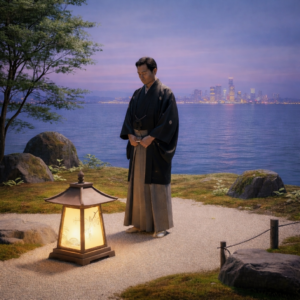
The Light of an Andon-A Culture That Appreciates Light and Shadow
Unwavering Conduct
The other day, while I was on a flight, I watched a flight attendant carefully attending to passengers and serving meals.
It reminded me once again that in a confined space, each person’s manner of conduct itself can greatly influence the atmosphere of the entire place.
Remaining calm in any situation,
and behaving in a way that does not cause anxiety to others—
this way of acting closely aligns with a sense of beauty that Japanese people have long valued.
In Japan, the attitude of:
・behaving consistently, no matter the situation
・being mindful not to cause discomfort or unease to others
has traditionally been respected as the beauty of restraint (慎みtsutsumi).
This is not an inborn personality trait, but something cultivated only through daily discipline and the steady accumulation of inner awareness.
Before electricity became widespread, andon(行灯、traditional Japanese lanterns)were used as nighttime lighting in Japan.
The soft, faint light of an andon carries meaning that goes beyond mere practicality, and even today, andon remain popular as interior lighting.
The gentle glow filtered through washi paper softly illuminates only what needs to be seen, never dominating the space.
Because the light is subdued, one can also appreciate the subtle gradations of shadow that emerge around it.
In the modern world, we are surrounded almost everywhere by uniform, powerful lighting.
As a result, our sensitivity to shadow itself seems to be gradually fading.
A light that does not assert itself.
Light and shadow that do not cancel each other out, but instead exist in harmony with the space.
This sensibility lies at the very core of Japanese aesthetics.
The Beauty of Restraint-Why Quiet Movement Holds Strength
Within Japanese culture, there is a sensibility that holds that:
True power emerges precisely
when unnecessary movement is eliminated.
Many people try to make themselves appear larger through loud voices, flashy gestures, or strong self-assertion.
While this may draw attention temporarily, its effect rarely lasts.
This is similar to excessively brightening a room or overly cooling a space.
When brightness or coldness becomes uniform, the subtle variations that exist between them can no longer be perceived.
By contrast, those who behave modestly and with care are constantly thinking about:
how to refine themselves
They tend to:
・wear high-quality items discreetly
・choose simple designs
・avoid boasting
・refrain from trying to appear larger than they are
・improve themselves steadily and quietly
This stance—small, quiet, yet internally strong—is precisely the aesthetic that Japan has cherished for centuries.
In contrast to what is often called the Western “aesthetic of self-assertion,”
Japanese culture has emphasized not the beauty of making the individual stand out, but rather:
the beauty of arranging and harmonizing the whole
—the beauty of harmony.
That said, this way of thinking does not exist only in Japan.
For example, consider Johannes Brahms’s Symphony No. 3.
This work has an exceptionally unusual structure for its time: all four movements end quietly, in pianissimo.
Rather than concluding with grandeur, it compresses passion into stillness.
This restrained ending creates, paradoxically, a powerful sense of conviction and a deep lingering resonance.
In this sense, it can truly be said to embody the same idea found in Japanese aesthetics:
Power resides within stillness.
Shosa-Techniques That Embody Deep Quietness
In Japan, “quiet movement” is not simply a modest attitude.
It is a highly refined skill—a cultivated form of bodily culture.
Recently, while watching a pianist perform at an international competition,
I saw a Japanese performer producing beautiful tones accompanied by large, expressive gestures.
That, too, can be considered a valid form of expression.
However, from a Japanese cultural perspective, when bodily movement becomes excessive,
one may feel that the very sound meant to be conveyed begins to lose its presence.
The movements in the tea ceremony stand in clear contrast.
They are never exaggerated, but instead are:
・steady
・quiet
・orderly
・free of waste
These movements are not passive.
They represent active consideration—a deliberate effort to avoid disturbing the space and to respect the feelings of others.
The tea ceremony avoids making sound, avoids exaggerated motion, and relentlessly pursues a beauty stripped of all excess.
Kendo, too, is often thought of as a violent or aggressive martial art at first glance.
Yet the more skilled the practitioner, the more “quietly” they fight.
Beginners tend to swing widely and apply excessive force in an attempt to strike powerfully.
Experienced practitioners, on the other hand:
・generate sharp strikes by not overexerting force,
instead making use of natural downward movement.
I once learned the following words from a master instructor:
“Try gently releasing the bamboo sword from your hands.
Even if you do nothing, it will fall downward. That is natural force.
First, learn to recognize this force.”
A bamboo sword falls straight down, obedient to gravity.
By understanding this natural fall and layering technique upon it,
one can eliminate waste and draw out maximum effectiveness.
Miyamoto Musashi, in The Book of Five Rings(五輪書), repeatedly emphasizes the importance of
“cutting without force” and “swinging quietly.”
Letting go of tension, he teaches, ultimately leads to the strongest technique.
To truly understand Japanese shosa—codified bodily conduct—it is essential to reflect deeply on what it means to:
move quietly.