Wind Chimes — Sensing Invisible Wind as “Presence”

Wind Chimes — Sensing Invisible Wind as “Presence”
Reality is formed through our senses.
Wind Chimes — Sensing Invisible Wind as “Presence”
We tend to seek a single “correct answer.”
Entrance examinations, professional certifications, performance evaluations, numerical targets at work—
in modern society, a “right answer” is almost always prepared in advance.
Through education, we have been trained to feel uneasy whenever we deviate from it.
Without a correct answer, we feel unsettled.
We become uncomfortable in situations that cannot be clearly divided into black and white.
However, when we carefully explore Japanese culture,
we begin to notice that there are many traditions that allow us to feel and enjoy without deciding on a single answer.
A representative example of this is the wind chime(風鈴、furin).
A wind chime is not merely an object that makes sound when swayed by the wind.
Through a single, cool-toned note, we naturally sense that:
an invisible breeze has just passed through the space.
A wind chime does not explain, “The wind is blowing.”
It simply leaves behind one sound.
Yet through that single sound,
we feel as if we have experienced the wind itself,
and we imagine “coolness” as a bodily sensation.
At the moment we hear the sound, it feels as though the temperature of the air touching our skin has changed.
We experience “coolness” sensorially.
Even if there is actually very little wind,
the sound invites us to imagine its presence.
This suggests that our senses shape how we perceive reality.
Because perception is sensory, it naturally differs from person to person.
One person may feel loneliness in the sound;
another may feel calm and comfort.
There is no correct answer.
One simply savors a world without fixed answers through one’s own sensitivity.
This is precisely the refined way of enjoyment that Japanese culture has long cherished.
―――
The Parable of the Elephant — A Way of Knowing That Does Not Seek a Single Correct Answer
Are you familiar with the parable of the elephant?
It is commonly known as “The Blind Men and the Elephant.”
This parable originated in the Indian philosophical tradition
and has been passed down for centuries in Buddhist and Jain contexts.
Although the number of characters and expressions vary by region and era, the basic structure remains the same.
People who are blind each touch a different part of an elephant
and give completely different explanations of what it is.
Generally, this story is interpreted as follows:
・the danger of partial understanding
・the idea that truth cannot be known without seeing the whole
・a warning similar to “missing the forest for the trees”
In other words, it serves as a caution against being trapped in a limited perspective.
However, when viewed within the context of Japanese culture,
this parable takes on an entirely different meaning.
―――
Multifaceted Truth Without Competing Over “Correctness”
What is often debated in this parable is the question,
“Who is correct?”
・Is the person touching the trunk mistaken?
・Is the understanding of the one touching the leg insufficient?
・Is the one touching the ear far from the truth?
In modern society, we tend to judge who is “most correct.”
Yet in this parable, no one is lying.
For each person at that moment,
the part they touched was undeniably “true.”
From a Japanese perspective,
everyone is considered correct within their own position.
This is because the world naturally appears differently depending on:
・where one touches
・the distance of one’s involvement
・one’s individual senses and experiences
Japanese culture does not fix truth from a single direction.
Instead, it affirms the existence of multifaceted truth.
―――
Sensing the “Presence” of the Whole from a Single Point
The three individuals do not know the full form of the elephant.
Yet at the moment of contact, all of them sense that:
・this is not a small creature
・it is alive and moving
・it has great weight and presence
In other words,
they do not understand the whole,
but they do grasp its presence.
The trunk, leg, and ear are only fragments of the elephant.
Yet in Japanese culture, it is believed that:
the presence of the whole resides within each part.
・We see the season in a single flower.
・We sense the vastness of space in a single sound.
・From one point of contact, we imagine the entire world.
This is the Japanese way of knowing.
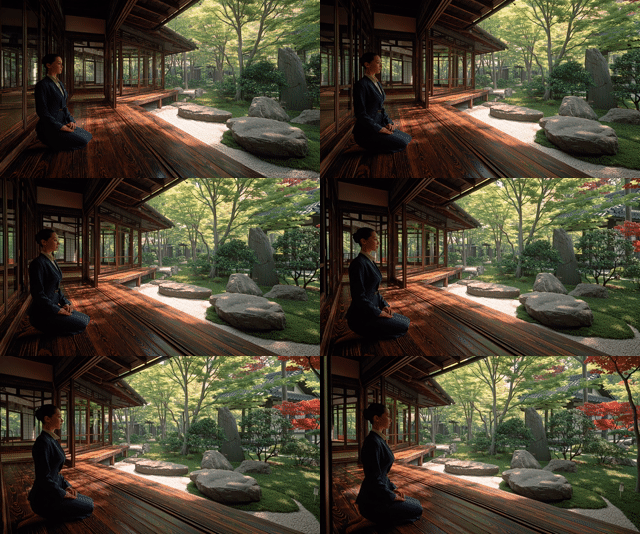
Ultimately, it is difficult for human senses alone to fully grasp truth.
That is why, rather than denying one another,
only by connecting different perspectives does the reality of “the elephant” emerge.
A Culture That Does Not Treat Differences as Errors
The explanations given by the three people certainly differ.
However, what Japanese culture asks is not:
“Who is correct?”
but rather,
“Why did each person feel differently?”
The difference does not arise because the elephant changed,
but because the point of contact and the individual sensitivity differed.
Japanese culture does not:
・exclude these differences
・force them into uniformity
Instead, it often finds beauty in the discrepancy itself.
Just as the sound of a wind chime is heard differently by each person,
and just as there is no single correct interpretation,
the parable of the elephant can be read as a story that depicts a world
in which diverse perceptions coexist simultaneously.
Shosa — Expanding Possibility Without Deciding Through Thought Alone
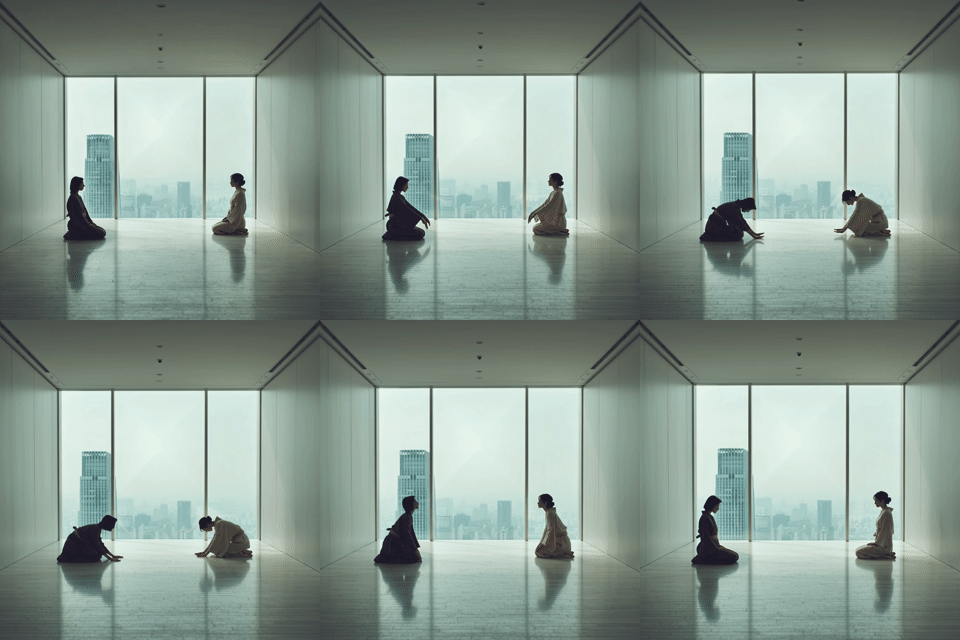
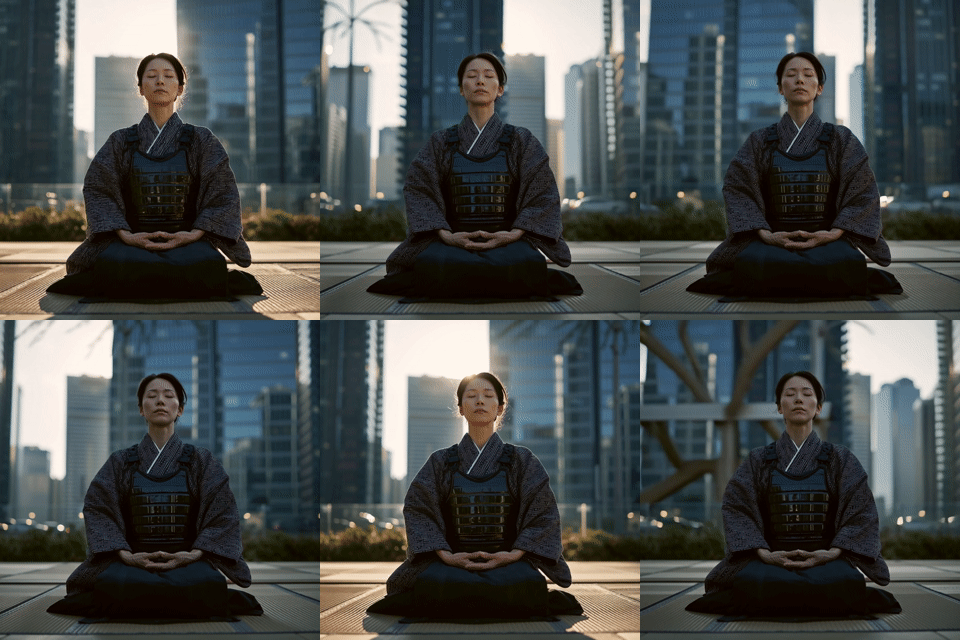
This sensitivity to “presence” has been refined into concrete techniques
through shosa—intentional bodily conduct—in Japanese martial and performing arts.
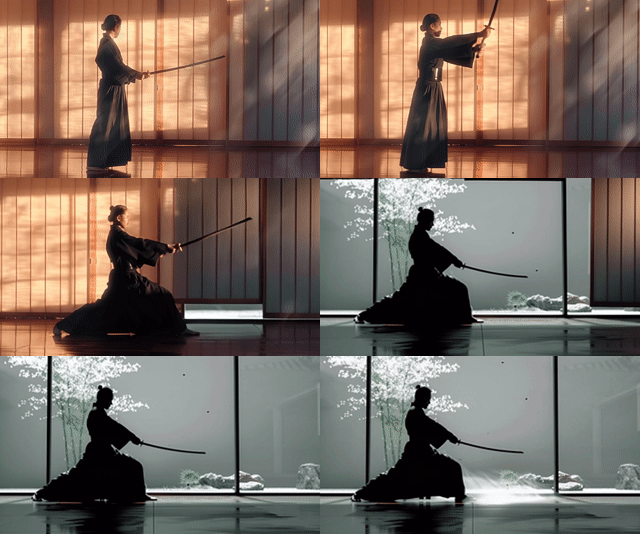
In kendo(剣道), beginners tend to think, “I will strike,” or “I will hit,”
becoming fixated on how they should move and trying to decide the outcome in advance.
Experienced practitioners are different.
・They can strike, but do not
・They can move, but remain still
・They can defend, but choose not to (instead stepping forward)
This is not a passive attitude.
It is an advanced bodily skill in which one senses the presence of the opponent’s movement,
without fixing oneself to a specific action,
standing while containing all possibilities.
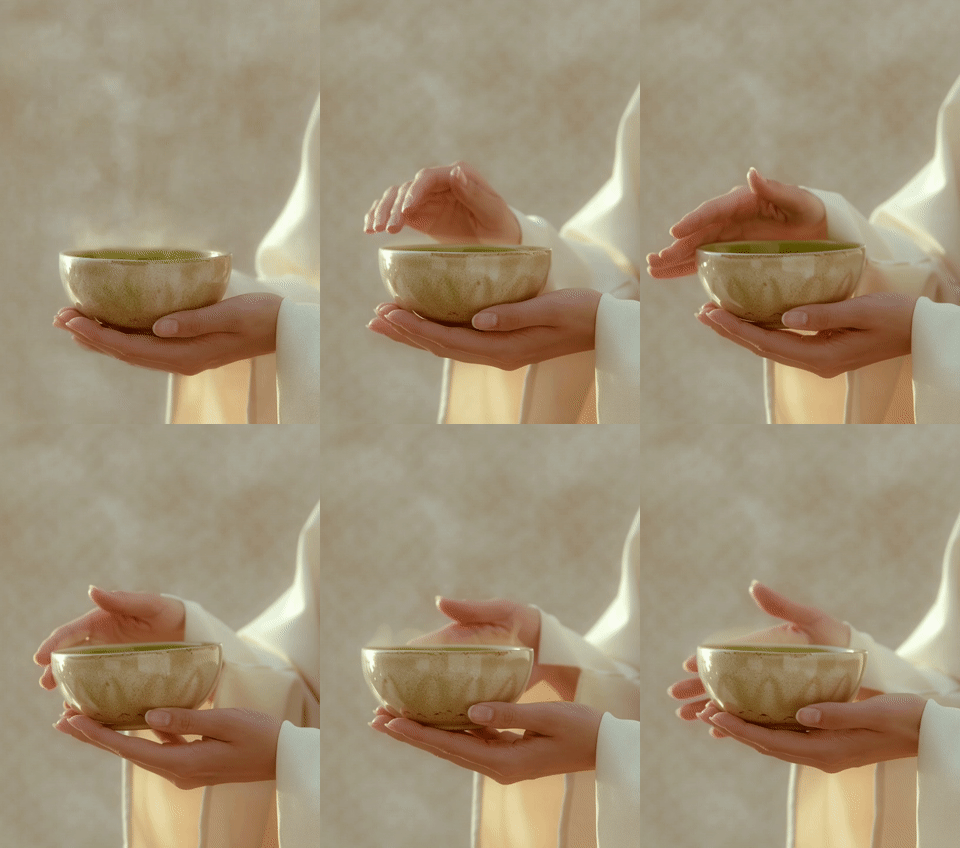
The same applies to the tea ceremony(茶道).
During otemae (お手間、the formal preparation of tea),
as long as one is thinking intellectually about what to do next, the movement becomes strained.
A seasoned practitioner senses the presence of the entire space and responds appropriately.
Able to move at any moment,
yet deliberately not clinging to a specific form.
By maintaining this state of tame(溜め、a held readiness).
one can respond freely to any change in the other person or the situation.
As a result:
・space shifts
・time shifts
・the unfolding itself changes
An entirely different world appears.
This is not the passivity of always reacting late.
It is not mere waiting or observation.
It is choosing not to move,
after cultivating a body that can move instantly.
Just like the parable of the elephant,
once we decide, “This is what it is,”
all other possibilities disappear.
The world is not simple enough
to be contained within a single answer.
Shosa is bodily wisdom that prevents us from rushing to define the world.
To think not with the head but with the body—that is exactly what this means.